3edata, Top Local Data Stripping

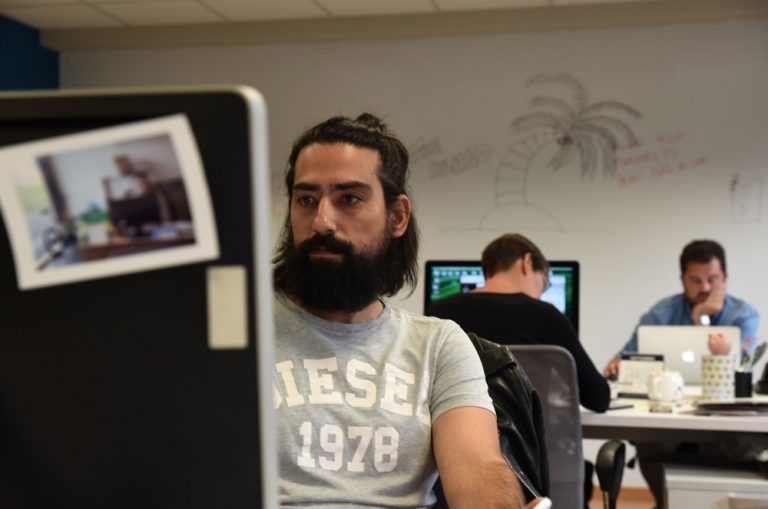
Extracting all the possible information that the locality offers to start up projects of a very diverse nature is the objective of the 3edata “lucense” spin-off, a company that despite its short trajectory has already managed to find a place to position itself in the field of consulting and management of infrastructures, environmental or agricultural-livestock projects.

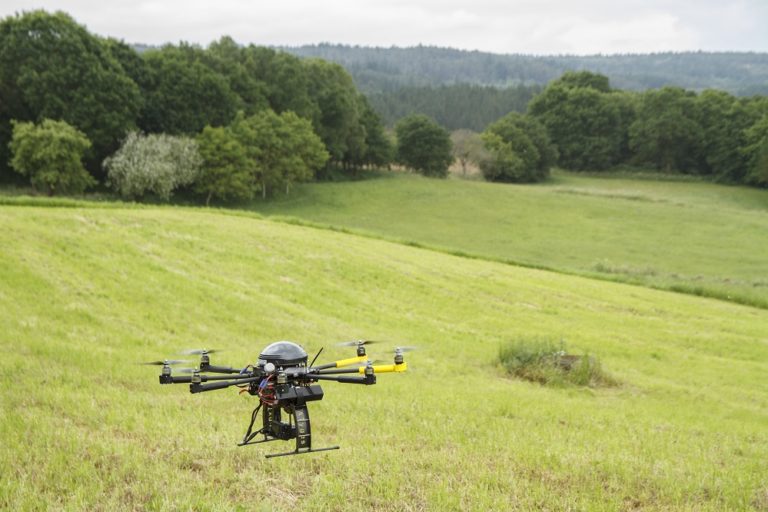
Data mining through the use of sensors, satellites, drones and light aircraft is the beginning of the process that leads the company to later develop a diagnosis on the features of the terrain and the possibilities that exist to implement it within some project or try to manage the ones which are already being developed.

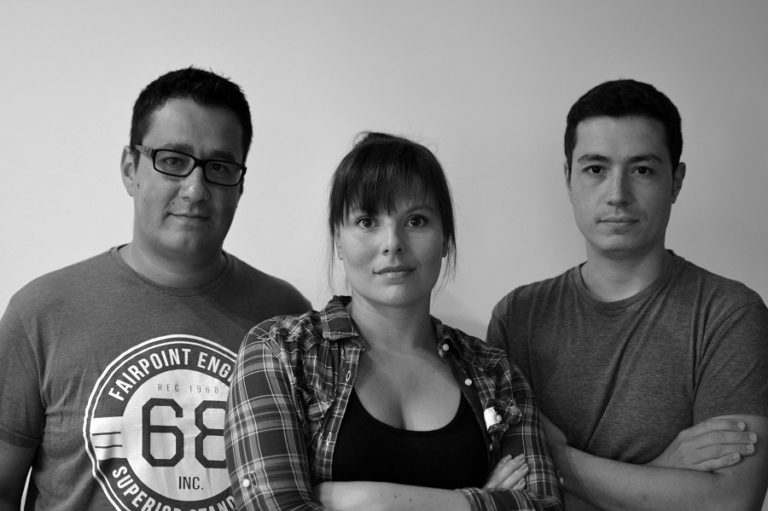
Marco Rubinos, project manager of 3edata, explains that the company was born in February 2016 with the base of knowledge and experience developed over a period of three decades by himself and his partners Carmen Cillero (R & D) and Boris Hinojo ( Technology) within the Institute of Agricultural Biodiversity and Rural Development (IBADER) on the Lugo Campus.

“After 15 years of work,” says Rubinos, “we have decided that it is time to go a step further and create a project that allows the transferring of the knowledge acquired in college .” A few months after beginning their entrepreneurial journey, they got funding which accounts for an investment of 180,000 euros and currently their business volume already exceeds half a million euros. The growth prospects for the coming years are very positive.

“Coming from a college environment and operating in a sector that is not yet very mature, has provided the possibility of developing technologies that will allow us to launch new services and improve those, we are already providing,” says Project Manager 3edata. The company was selected within the Via Galicia 2016 program.

The activity of the company focuses on the agroforestry field, with applications in the field of viticulture, management of forest stands and crops. But, in addition, 3edata, operates in other areas such as the management of electrical infrastructures. the monitoring of reservoirs or the development of R & D projects in the environmental field.
Creative Designs Devised by Children

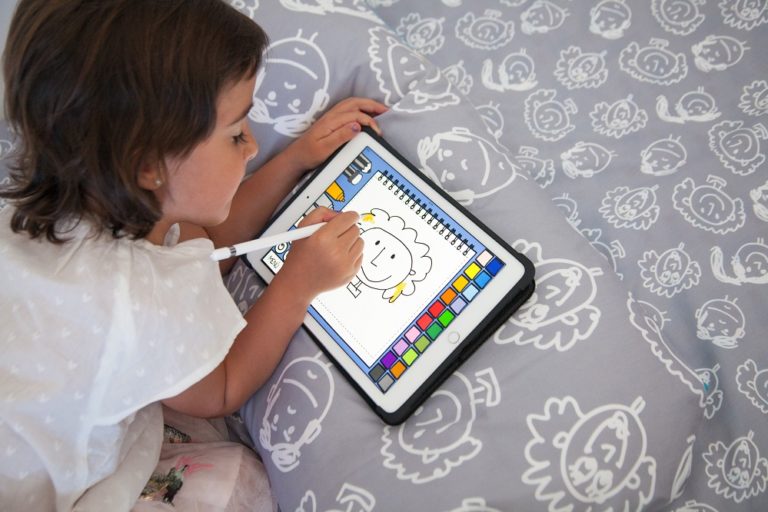
The idea arose in the head of a mother who began to think how one could take advantage of the talent that her children showed when making drawings on paper. In just a few years that lucky turn of events has eventually become a business idea, which is on its way to becoming a successful business. Mr. Broc currently has six employees and aims to multiply his turnover as of 2018 with the new computer tool he has already begun to use.

Sonia López (izda), fundadora de Mr. Broc

Sonia Lopez Mera, founder of the company, explains that the project began three years ago with tests carried out with the help of family and friends, but the turning point occurred in 2016 when it was decided to move from a craft business model to a company that, in a short time, aspires to take a giant leap towards internationalization.

What has not been changed is that the children’s drawings are still the starting point of the project. These sketches can now be made automatically on the company’s website (www.mrbroc.com) which has a tool called Broc Studio that allows anyone to make the sketches and see how they could be in the various objects that could be purchased with this design The tool is free and of free access and only pays for the products with the designs already inserted.

The founder of Mr. Broc is excited about the possibilities offered by this new tool that began operating last November and with which they hope to take a big step forward in the growth of the company. “Our computer developers have managed to create an application, that in a way, thinks and offers those who draw the best alternatives to turn their sketch into a design for a real product,” says Sonia Lopez.

The world cuisine at the click of a button

Mercado Flotante was born with a purpose: that everyone will be able to cook any recipe in the world from anywhere in the country.

It was the year 2008 when Miguel Briones, CEO of the company, at that time manager of large banking projects, was given him a book of international recipes. “I was not able to do even 95% out of the whole recipe book because I did not have any place where to get these ingredients from,” he tells us.

He´s noted this moment in time as the kick-off of the project, but it would not be until 2015, when together with Lorea Castroviejo, from Donosti, the idea took off. “I do not think we are visionaries, but we knew we had to wait for the food industry to become more fashionable,” says Miguel.

Lorea Castroviejo and Miguel Briones are the founders of Mercado Flotante

The name Mercado Flotante refers to markets in South Asia where sellers arrive and sell off the boats on rivers. An exotic name for an online store with exotic products.

Miguel brags about not having even competition in Spain, “and from what we have seen, in the world, a store with a catalog of international products greater than ours… I doubt it”. With 4,800 users and 1,000 fixed customers, and in the absence of introducing fresh and frozen products, Mercado Flotante is making its way into the online food tech sector.

Success rests on three basic pillars. First, the breadth of the offer, which is not only about products, but also brands. The customer service, which is noticeable from the moment you look for any reference or assessment of the company.

Many talk about the exceptional customer service that they offer, how careful they are with the labeling – and therefore have a growing community of organic consumers and vegans behind them- or how they handle carefully their orders. And third, the innovation that is being carried out from Mercado Flotante to simplify the company’s processes and generate vast content.

Bendita Cocina: Turn your House into a Restaurant

0

Galicia is a place where traditionally food occupies a main place. But in recent years the emergence of this sector worldwide has been unimaginable. Chefs are treated like rock stars, and gastronomy talent shows take up large screen shares. Nobody imagined that such an ancient craft could become so fashionable.

«At the bar we all play the role of football coaches and we talk about football like professionals do, and that is happening nowadays with our cuisine; We all know what a reduction is, “says Isaac Carrera, CEO of Bendita Cocina, a platform based in Nigrán with which you can hire chefs who cook for you at home, for catering companies and for diners at restaurants. A manager of culinary budgets.

Isaac is also CEO and co-founder of Elemental Chefs, a communication agency that has a large number of customers in the food industry. Company from which the idea is born. On the one hand by a campaign of the agency for Galicia Calidade a while ago, and several years ago dinners were raffled to be prepared by professional chefs at the winners` home.

We do not have to have a special kitchen for enjoy Bendita Cocina

On the online platform you can hire the service in two ways: either a la carte, looking for a chef or a specific menu, or entering the specifics of the event and the chefs who work in the area will offer you their menus.

We do not have to have a special kitchen. With an oven, a microwave, stove and refrigerator are usually good enough. And if they need something else, the cooks will take it along with them. The same as the ingredients, bought by the chefs themselves. “The general feedback is very good, because you are willing to have fun.” As soon as desserts are served and on the table, the cooks will leave and the kitchen remains as good as new.

A start-up as an experiment laboratory
For the founders of Bendita Cocina and Elemental Chefs, this platform is a way of doing those things that the communication agency does not dare to proposition to their clients. “In this country we have the habit of turning start-ups into companies too soon, taken experimentation capacity away from the equation,” says Isaac. But he admits that they can do it because Benditta Cocina is not one of the pillars of their economy.

“We know it’s a profitable project – humble, but profitable – but what we want is to be a benchmark in the market.” That’s why the company has evolved since the very beginning. From home services, they began offering dinner packages to large companies, such as Rector de Amandi, Maho or Galicia Calidade itself. And after passing through the Via Vigo accelerator, they have added up services such as catering and restaurants, because “people have been starting to contact us for a wedding or a Eucharist celebration, and you can not send one and only chef just to cover every single event”.

Matprint, innovation for the medicine of the future

The investigations carried out at the Institute of Ceramics in Galicia, belonging to the USC, and for three decades have been the basis of a new business project that has been garnering some attention in recent times. Matprint is the name of this initiative that focuses on the commercialization of biocatalysts and implants, made with 3-D printing, which could be applied in the bone regeneration of patients who have suffered various diseases.

Biocerámica para rexeneración ósea

Francisco Guitián, director of the Institute of Ceramics and professor of Materials Science, explains that since the institute has already created companies like Keramat that sells implants similar to those that they now want to introduce into the market but are “less sophisticated” than those that they have been researching at Matprint.

“What we do now is to modify the structures of these implants but the materials have not been changed. If the project goes ahead, it will not be necessary to carry out clinical trials in humans because the material is the same, ” says Guitián, who recalls that Keramat implants already have been approved for commercialization in Europe and the United States.

At present, animal tests have been carried out and, in collaboration with CIQUS, catalysts have been tested in drug synthesis. “Now the issue is to see if these new implants and biocatalysts can be profitable industrially or semi-industrially. The idea would be to create a company to market them or sell patents”, says Guitián.

Matprint has been financially supported with just over 240,000 euros by the Ignicia program for its development. In July of next year it will be known if it is possible to carry out the marketing project that the founders of the project want to carry out.

The implants developed by Matprint could be used for the bone regeneration of people who have suffered accidents or tumors in which the bones have been affected. The Ceramic Institute itself provides the artificial bone to perform the implants and the researchers’ work focuses on the development of the structures that facilitate the cells to end up developing in the implanted material.

According to Guitián, Matprint collaborates with the Health Research Institute (IDIS), where the tests are carried out, and also with the CIQUS. In total there are six main researchers involved in the project and another ten people who collaborate with them.

Peryco: Comparison Shopping Engines take on the beauty industry

0

The proliferation of online commerce has allowed consumers to have much faster access to information about the products they want to purchase. And that they can also make pre-orders before their purchase comes to fruition. What encourages the comparison of products, models, brands, points of sale and, above all,  are their prices.

To make things easier for us and not have to visit multiple platforms, the comparison shopping engines were created. And in 2016, Peryco -a synonym of Perfumery and Cosmetics- comes to cover a sector in which practically none existed then: that of beauty.

Consola de Peryco.
Consola de Peryco.

In a first phase the price of perfumes is compared, but when coming in different sizes we must also value the quantity in each bottle. “People tend to think that the more, the cheaper, but in perfumery that is not always true,” explains Manel Soto, CEO and founder, along with his brother Jordi and Sandra Pena, Peryco.

When talking about comparing perfumes, we are not talking about comparing fragrances, but about which of the containers contains the highest concentration. We have two types mainly: an EDT (Eau de Toilette) or an EUP (Eau de Parfum). “There are no concentration values established by the industry, but there are ranges,” says Manel. And in this way, an EDT has less concentration than an EDP. It will be our decision, under our personal smelling sense to choose which of the two types we want.

In addition to fragrances and cosmetics, Peryco is also incorporating offers at beauty centers. Today it has 100 centers, but they expect to reach 2,000 in March.

The origin of the idea, like so many others, comes from Manel’s own experience when searching online for a perfume to give away at Christmas. Both he and his brother Jordi, both from the web scraping for other brands (technique used to get information from a website), realized that there was no tool to facilitate the enormous work of comparing prices.

The company, which operates in Spain with a monthly traffic of 60,000 people, is ready to go abroad. The web is already set up and the expansion to France under a new brand, Wibeti, was imminent. Later, they will tackle Latin America, with Mexico, Brazil and Chile as their main areas.

And although they have received funding from the accelerator of Via Galicia, they need it as an important cushion to start the company and start outsourcing services. «Here you have to know how to do everything, but quality is well paid».

For them, the future and essence of Peryco lies in moving from a comparing shopping engine to a community, and from there to a market.

Aistech Space: the democratization of space

0

The first artificial satellite that humanity put in space was a Soviet one, was 83.6kg and formed by an aluminum ball of 58 centimeters in diameter and four antennas of 2.4 and 2.9 meters. The Sputnik 1 took over on October 4, 1957 the conquest of space. From that moment on, satellites did nothing but increase in number: bigger, more powerful and with more tools. And also much more expensive.

Satélite de Aistech.

For the students, both the price and the complexity of the devices gave a problem when developing their own models, assembling and testing them. But at the end of the 90s a Catalan professor of the Polytechnic University of California, Jordi Puig-Sauri, and the one of the University of Stanford, Robert «Bob» Twiggs came up with a solution: cubic satellites of 10 cm for these academic purposes. Cheaper and simpler than the traditional ones. The first was launched successfully in 2003.

“We closely monitor the evolution of the nanosatellites, and especially the companies in Silicon Valley that have been developing this technology for commercial purposes,” explains Guillermo Valenzuela, CEO and co-founder of Aistech Space.

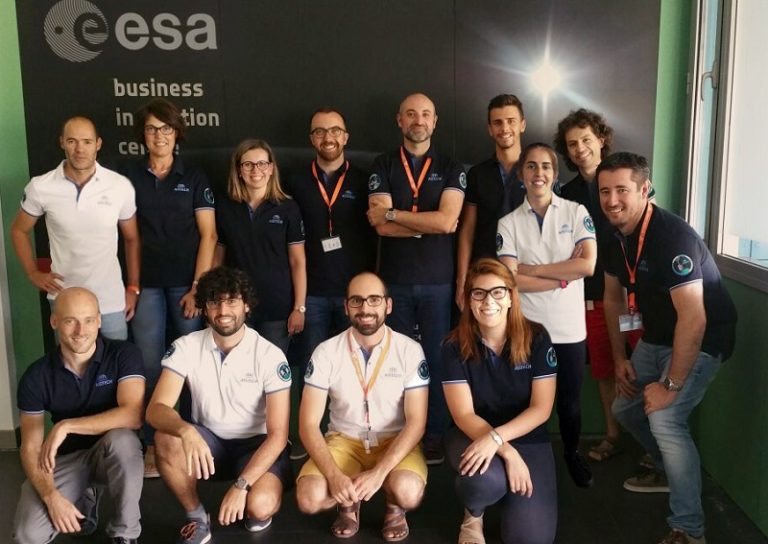
Based in Porto do Molle, Nigrán, moved in 2016 from Barcelona by the support of the Xunta, his company is dedicated to the development of cubesats for civil use. In 2015 the company was born, after a year of study, in which they discovered a niche market in aircraft tracking, bidirectional communication in remote areas and the screenshooting of infrared and thermal images from space.

The new space in front of the old space
The main revolution that brings this new types of satellites, which belong to the sector of the coined new term ´new space,´ is due to their low cost. Smaller devices and therefore easier to put into orbit. “Twenty years ago it was absolutely unthinkable for an small company of 14 people like ours even to consider the launching of a satellite into space,” says Valenzuela. “It was only up to Boeing, Airbus or Thales.”

“A nanosatellite is unique because of the size and because of the systems it has contained in it and they are the same as the ones inside a big satellite,” he explains. The difference is in redundancy and power, which generates a different work structure. While an old space satellite like the Galileo carries four clocks and two computers, only in case of flight failure, in a nanosatellite, the redundancy we get it from the nanosatellite that flies closeby.

Hence the need to have a constellation in the airspace, since failure rate is about 3-4%. “For us it will be a problem because we will not be able to bill clients with those satellites that expire early, but it is not the same to lose 3 nanosatellites than a single satellite of 500 million euros that has a financial return of 15 years.”

CoinsCrap: savings through residual income

0

In a world in which most of the cash exchanges we do every day are not physical, it would not make sense for our digital piggy bank to be so. CoinsCrap is simply our piggy on the phone. The app keeps the digital cash that we have left over after each payment, so that we meet our savings goals that we want to reach. As with the left over cash that our mother allowed us to keep when we were kids and ran around for errands.

Pantalla de Coinscrap.

“The idea was born when I saw my mother-in-law, who put all the coins she had in a water bottle,” says the CEO of CoinsCrap Finance S.L., the Ourense David Conde, whom we already met via another financial management application, Senseitrade. “We wanted to combine financial planning with the rounding up of numbers, so that people could make their dreams come true”.

For David Conde, the main objective of this product is to democratize savings among millennials, with an easy and fun process. And above all, it is not a hassle.

The on-line-registration-takes about 2 minutes. And start filling out our virtual piggy bank too. We choose how much our next acquisition costs, kick or need, how long we expect to arrive at the amount it costs, and the amount of money to round up for each operation: one, two, five or ten euros. If the cinema costs us 6.50 and we have rounded it up to € 1, CoinsCrap withdraws 50 cents from our account and puts them in our piggy bank.

We can also make a fixed monthly contribution, because it does not always arrive with the left over cash. “We did a pilot program in Portugal, and the average savings of users every week, only with rounding, was between 12 and 15 euros.Those cents come out of card transactions and bank receipts”.

logo-coinscrap

The virtual piggy bank is an insurance of savings of Caser, that although it offers us very low profitability, from 50 € we can withdraw everything what we have saved, without any cost. “We have chosen this type of product because it is the fastest format to register. It is enough with filling out a form and send a copy of your photo ID card “.

In the current phase of the application we can only deposit the money in savings insurance; however, in CoinsCrap they have been implementing other options. Some of them we can see them already in the home screen, even if they are not operational. As an equity investment fund in the short term, which provides higher returns than savings insurance. And also a retirement fund. CoinsCrap will calculate the monthly savings that the user should make in order to cash in for his pension in the future. Although they make it clear that it is very difficult to know how much we will charge when we retire, it will rely on the future financial situation and what we have contributed to the system in our lifetime.

Carmela Silva: “Pontevedra has all the benefits for an entrepreneur to succeed”

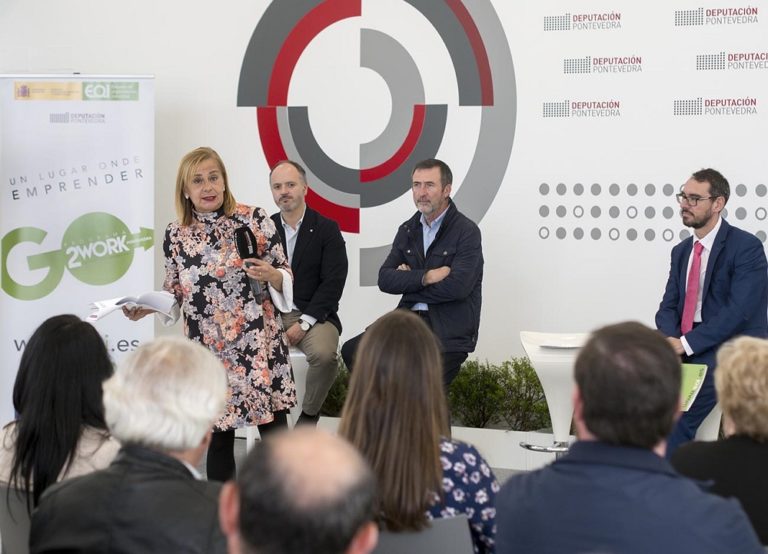
The president of the Diputación de Pontevedra, Carmela Silva, went decisively for the support of business initiatives that are created within the locality as she considers that they are a source of employment and wealth that is necessary to carried out by the local government. The talent that treasures the human capital that exists in Pontevedra and the favorable cultural, natural and social environment that the county has, makes it, in her opinion, a privileged place for any entrepreneur who wants to build a business project, whatever their area of action it might be.

Carmela Silva. Foto: Anxo Iglesias

-What are the main lines of action from the County Council when it comes to supporting entrepreneurs or businesses?

-We have many lines of support. We have in the industrial estate of Barro-Meis with offices and warehouses for business nurseries and the recently opened Coworking and Fab Lab. This type of initiatives allows us to undertake new business projects at competitive prices well below the market. They are very expensive resources because the prices of offices and warehouses are high in the market. We also have the SmartPeme network, which is located in seven spaces in each of the districts of Pontevedra, where SMEs, self-employed, freelancers and entrepreneurs are given information, training, advice on a daily basis about the use of ICTs. In this way the companies that already exist and those that are going to be incorporated can get all the necessary information about the resources they have access to and the new technologies so that their businesses are more efficient, more benefits are obtained and more employment can be created. Starting from February, there will be a new SmartPeme headquarters in the Barro-Meis polygon. We have specialists in the various sectors: tourism, agriculture, culture, natural stone, etc. We have a large package of measures to try to modernize all the productive sectors of the locality.

-What objectives do you pursue with the recent implementation of Coworking and the Fab Lab?

-The main thing is to ensure that all people who have an entrepreneurial idea in the locality can turn it into something real. The Fab Lab can be used by all those who take part in in the Coworking and any entrepreneur in the county who wants to have access to new technologies to develop their projects. It will be an open space for women and men to have all the tools of innovation that are very expensive and of which are not always available for them. They will have the best and most innovative technologies that, in addition, we will incorporate them into the Fab Lab when they come. There will be a total of four events of the Coworking in two years, with which may come up with between 80 and 100 new business projects.

-What comparative advantages can entrepreneurs find in the province of Pontevedra?

-We have a very powerful university that dedicates its action to everything that has to do with the different industries and creativity. Uvigo generates the knowledge so that the county has excellent business people. We have knowledge so that you can create anything business wise, from the metallurgical industry to a cultural company because the University covers all those fields. In addition, the county is in an environment that has leading companies in various sectors: naval, fishing, automobile. We have a level of innovation and automation that few places in the world do. We also enjoy a privileged natural and cultural environment, with a historical trajectory and with the enormous talent that the people of this county have. To all this we must add that we have a global mentality because we have been immigrants abroad too.

-What is the role of the administrations in terms of supporting the local business people?

-We have some administrations, I feel that they are not all, that we are aware that our role has changed and that we must lead technological change by being more business oriented and more proactive. In this county, there is a lot of talent that has to go from darkness to light and that is what we have to do with the administrations. We are dedicated to the policy of changing society and, in this case, that is being achieved by offering infrastructure, room, tools, spaces and projects to entrepreneurs that allow the county to remain a place with much economic activity and job creation. We are a very powerful county in the region

Safe ID with biometric technology

The research, carried out for years in the Biometrics department of the Gradiant technology Center in Galicia, has resulted in the Face IDNN project, which is based on an innovative solution to verify the identity of a person by contrasting their image with the photograph of an identity file , from your mobile or computer in real time. It is expected to have the first prototype by mid 2018 and has been approached by several likely partners to bring this technology to the market.

O sistema utiliza o DNI para validacións

The project has been included in the Ignicia program and will have funds worth half a million euros for its development. Esteban Vázquez, Head of Biometrics Gradiant, explains that from this technological center they have been working for quite some time with technologies applicable to facial recognition and are now ready to launch some type of business initiative to market this innovative solution.

The novelty of the Face IDNN identification method is the commitment to using an existing ID file, which avoids having to make a previous registration of the fingerprint or face to make the identification a reality. The process consists of taking a photograph of the person Photo ID card or passport with the mobile phone or computer and collating it, from the same device, with the face of the person to be identified. The system checks in real time if it is the same person and thus the operation is carried out and can definitely be authorized.

Vázquez explains that this identification pathway was chosen because there is a demand from certain business sectors (banking, telephone companies, etc.) in order to identify clients from a file, instead of using other systems such as a digital fingerprint.. “We are talking to several potential clients who have already shown interest in our system because it fits well with what they have been looking for,” adds Vázquez.